
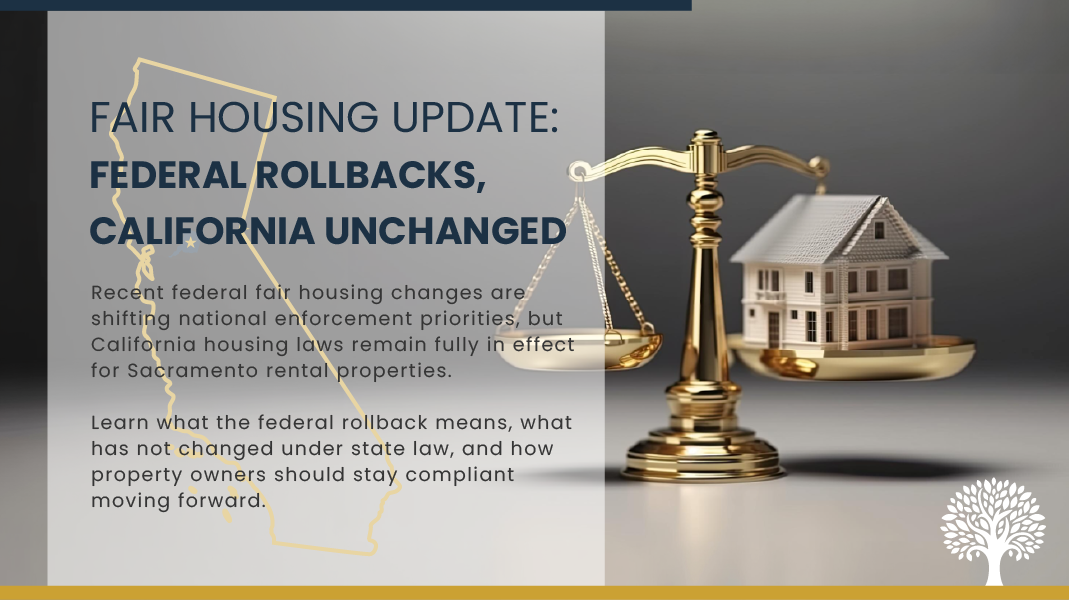
Fairfield Fair Housing Rules Remain Unchanged Despite Federal Rollbacks
What Fairfield Housing Providers Need to Know in 2026
Recent shifts at the federal level are changing how fair housing laws are interpreted and enforced nationwide. However, for housing providers in Fairfield—and throughout California—the practical rules governing rental housing remain firmly in place. State law continues to apply strict fair housing standards, regardless of evolving federal guidance.
This distinction is especially important for owners and managers operating in Fairfield and the broader Solano County market, where compliance expectations are shaped far more by state and local requirements than by changes in federal enforcement posture.
Understanding the Federal Shift in Plain Terms
At the federal level, housing authorities have recently taken steps to pull back from certain interpretations of fair housing law that relied heavily on the concept of discriminatory effect. This legal theory focuses on whether a policy that appears neutral on its face ends up disproportionately affecting members of a protected class, even when there is no intent to discriminate.
Historically, policies challenged under this theory have included:
Blanket criminal background screening standards
Rigid occupancy limits
Uniform income qualification requirements
The current federal approach signals a stronger emphasis on cases involving clear evidence of intentional discrimination, rather than policies that may create unequal outcomes without discriminatory intent.
While this represents a meaningful shift at the national level, it does not eliminate fair housing obligations, nor does it override California law.
Why Fairfield Landlords Are Largely Unaffected
California’s fair housing framework is broader and more protective than federal standards. State statutes and regulations continue to recognize discriminatory effect liability, meaning housing providers may still be held accountable for neutral policies that disproportionately impact protected classes.
In practical terms for Fairfield property owners, this means:
State-level enforcement remains active
Tenant complaints can still be investigated under California law
Courts may still evaluate housing policies based on outcomes, not solely intent
For landlords and property managers in Fairfield, compliance has always required close attention to California-specific rules. That reality has not changed.
Local Enforcement Matters More Than Federal Signals
Fairfield operates within a regulatory environment influenced by multiple overlapping layers of housing oversight:
California fair housing statutes
Regional enforcement priorities across Solano County
Local tenant protections and housing ordinances
Even if federal agencies reduce reliance on certain enforcement theories, California agencies and courts are not required to follow that approach. Housing providers should not assume that shifting federal guidance equates to reduced risk at the state or local level.
Fairfield’s workforce-driven rental market, including housing connected to nearby employment and military-related demand, places additional emphasis on consistent, defensible policies applied uniformly across all applicants and residents.
Policy Areas That Still Require Careful Attention
Housing providers in Fairfield should continue reviewing, documenting, and consistently applying policies in the following areas:
Criminal Background Screening
Screening policies should be narrowly tailored, applied consistently, and evaluated within appropriate context. Automatic denials based solely on criminal history may still raise concerns under California fair housing standards.
Occupancy Standards
Occupancy limits should be based on legitimate health and safety considerations and remain defensible as reasonable, rather than arbitrary or overly restrictive.
Reasonable Accommodations
Requests related to disabilities must continue to be evaluated through an individualized, documented process. California law maintains strict requirements regarding reasonable accommodations and modifications.
Advertising and Marketing Practices
Language used in rental listings, marketing materials, and online advertisements should avoid wording that could suggest preferences, limitations, or exclusions tied to protected characteristics.
What This Means for Sacramento, Roseville, and Concord
Although this discussion focuses on Fairfield, the same legal principles apply across Northern California rental markets, including Sacramento, Roseville, and Concord.
Sacramento: A highly regulated market where legislative and renter-protection pressures remain elevated.
Roseville: A growth-oriented rental market where diverse housing stock still falls squarely under California fair housing requirements.
Concord: A commuter-driven market where consistent screening and occupancy policies are especially critical across mixed tenant profiles.
Across all of these cities, state law—not shifting federal guidance—sets the compliance baseline for housing providers.
Best Practices Going Forward
To remain compliant in 2026 and beyond, Fairfield-area housing providers should:
Continue following California fair housing statutes without modification
Avoid loosening policies based on federal headlines alone
Clearly document the business rationale behind screening, occupancy, and qualification standards
Conduct regular policy reviews to ensure alignment with evolving state-level interpretations
The key takeaway is simple: federal enforcement changes should not be mistaken for a reduction in legal responsibility under California law.
The Bottom Line for Fairfield Housing Providers
While federal fair housing guidance may continue to evolve, California’s rules remain unchanged and fully enforceable. For landlords and property managers in Fairfield, this means the same high standards apply today as they did prior to these federal shifts.
Staying compliant is less about reacting to national policy signals and more about maintaining consistent, well-documented practices that align with California law. In a regulated and closely monitored market like Fairfield, that disciplined approach remains the safest and most responsible path forward.